The most accepted history of Filipino escabeche is that it is derived from Spanish escabeche which was introduced in the islands during the colonial period. But is it?
I have three theories about the origin of Filipino escabeche. And these theories, taken together or alternatively, may just provide a plausible explanation as to why there is white escabeche and red escabeche, and why our red escabeche is sweet-sour unlike Spanish red escabeche which is plain sour.
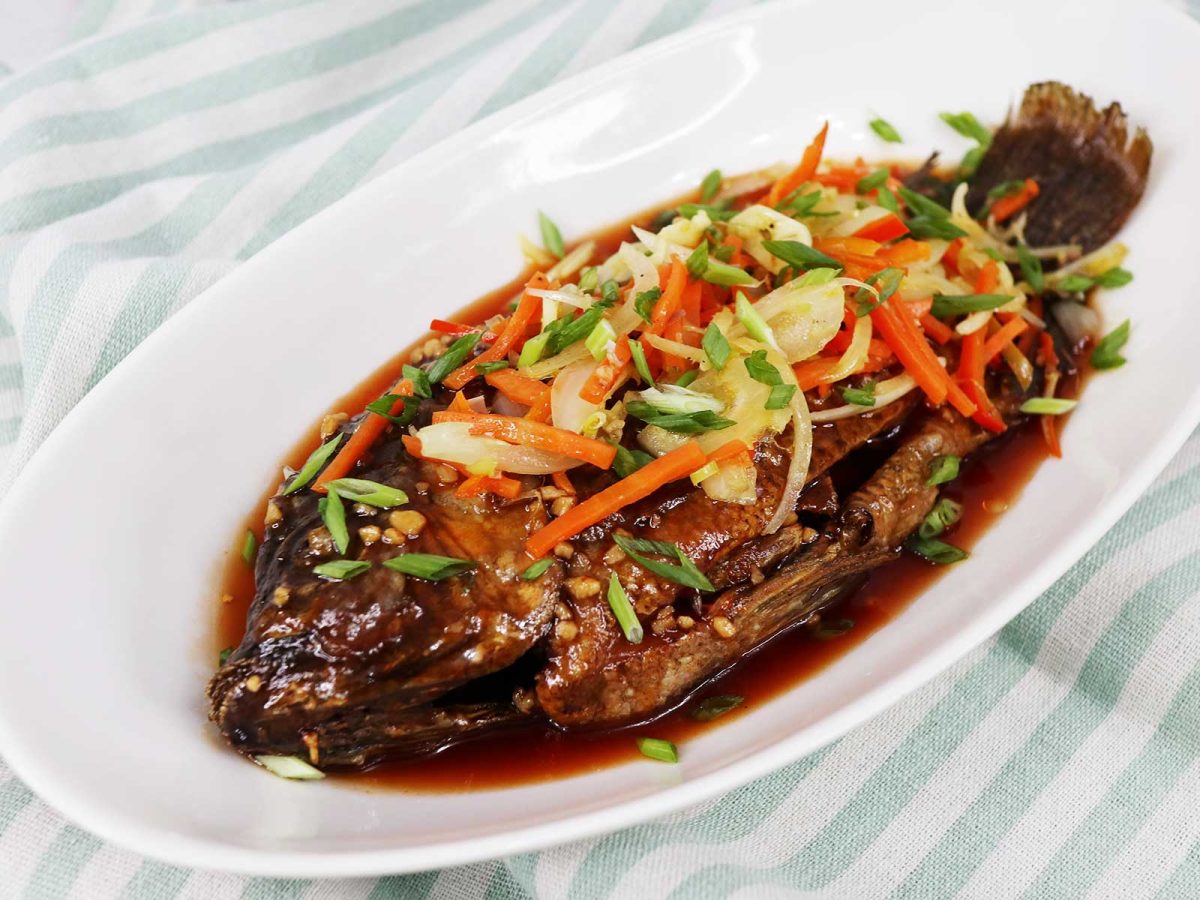
There’s white escabeche? Oh, yes. If you search Google for images of Filipino fish escabeche, the fish is covered with red sauce (the color courtesy of ketchup) and julienned vegetables. It’s easy to think that the sweet-sour red sauce is what defines the dish. But Filipino escabeche, it appears, is more complex than that.
Yes, I have encountered a different kind of escabeche (in Marikina, curiously) — white, not red and served with achara. The fish is marinated in the sweet sour achara pickling solution (or a mixture of something similar), drained, and fried. To serve, the fish is placed on a platter and garnished with achara (vegetables and brine).
If Filipino escabeche is an adaptation of Spanish escabeche, what accounts for the existence of both white and red escabeche in Filipino cooking?
White escabeche
Escabeche was originally a white sweet-sour meat stew. It is Middle Eastern, not native Spanish. The word escabeche itself comes from al-sikbaj, a Middle Eastern sweet and sour meat dish cooked with vinegar and honey (or other sweetener). It was a preservation method. It entered Spanish culinary tradition, and renamed escabeche, after the Iberian Peninsula (Portugal, Spain, southern France and Andorra) was conquered and ruled by Muslims beginning 711.
As escabeche evolved in what eventually became Spain, it transformed into a mostly acidic dish. The addition of vegetables like carrots provided a subtle sweetness to cut through the extreme acidity.
Red escabeche
Centuries later, Spain became a colonial power. In Mexico, one of its colonies, the Spaniards discovered paprika where it had been growing for millenia. They brought home the spice where it became a popular cooking ingredient. By adding paprika to escabeche, the dish turned red.
Theory #1: Filipino escabeche is derived from Spanish escabeche
This sounds reasonable. The Philippines was colonized by Spain which brought its cuisine. Many Spanish dishes, including red escabeche, were adapted and became part of Filipino cuisine. It explains why Filipino escabeche is red and why julienned bell pepper and carrot always make an appearance.
But this theory poses two issues:
- Spanish escabeche is sour. No sweetener is added except in the form of subtly sweet vegetables like carrot. Meanwhile, Filipino escabeche is sweet-sour like Middle Eastern escabeche.
- If Spain is the only source origin of Filipino escabeche, where did white escabeche come from?
Theory #2: Filipino escabeche is adapted from Spanish and Middle Eastern escabeche
The second possibility is that Middle Eastern al-sikbaj, the white sweet-sour stew that the Muslims brought with them to Spain, was fully integrated in the cuisine of southern Philippines which already had a large Muslim population before the Spaniards arrived.
Ergo, the preservation method of cooking meat, fish or vegetables with vinegar was not introduced by Spain. Rather, Filipinos adapted the Spanish name for a dish that was already being cooked in the islands before Magellan set foot on the island of Homonhon in 1521.
Theory #3: The Chinese connection
Theory #1 explains why Filipino escabeche is red. Theory #2 negates the redness but provides an answer as to why it is sweet-sour. Just how and when did these two features merge?
One possible explanation is that the Chinese (with whom the natives had been trading before the arrival of the Spanish colonists) had already introduced sweet and sour dishes in the island. By combining julienned vegetables (a feature of Spanish escabeche) with Chinese sweet and sour sauce, Filipino-style escabeche was born.
Which of my theories is correct, I don’t know. That’s why they’re theories. They may all be right and they may all be wrong. What can’t be wrong is my recipe for escabeche.