Giblets, defined
“Giblet” (usually referred to in the plural) is the collective term for the heart, liver, gizzard and neck. When buying a whole bird, the giblets are often stuffed inside the cavity. These are pulled out before the uncut bird is cooked. In many Asian countries, chicken soups and stews can include the giblets.
What the heart, liver and neck are is self-explanatory. And most people (you included, I hope) know what they look like and what their biological functions are. What about the gizzard? What is it exactly?
Now, things get interesting. Birds don’t have teeth, right? So, how do they chew their food? The answer is: they don’t. Chickens, quails, ducks, turkeys, pheasants and other gallinaceous birds have stomachs that consist of two parts: the glandular stomach and the muscular stomach.
The gizzard is the muscular stomach of birds
While chicken in coops are fed commercial poultry feed, left on their own to hunt for food, chickens eat insects, whole berries, seeds, worms and even mice. In fact, pretty much anything they can pop inside their beaks.
When food is swallowed, it goes into the “crop” where it is first stored. From there, it goes to the glandular stomach where enzymes are excreted to begin the digestion process. From the glandular stomach, the food passes to the gizzard where it is smashed with the help of bits of stone or gravel stored in it.
Stone? Gravel?Really?Ah, yes. If you’ve seen free-roaming chickens pecking and swallowing small pieces of stones, sand or gravel, and wondering if they will die because of it, well, the stones, sand or pieces of gravel—commercially sold as “grit”—are simply stored in the gizzard to act as grinder so that the food can be digested.
When the stones or gravel become too smooth to serve their purpose, they are excreted. The gizzard, however, is never without its grinders because the bird continuously collects material quite intuitively. So, the gizzard is tough it’s because it has to be. The muscles must be tough enough to allow the grit to grind the food without causing damage to the walls of the gizzard.
How to prep and tenderize gizzards
In order to make chicken gizzard palatable to us humans, it has to be cleaned and cooked properly. You need to rinse the gizzards well. Inspect each and every one. Pull out and discard any fatty tissues attached to them — especially all yellowish grainy bits attached to them. Remember that the gizzard is the muscular stomach of the chicken and all impurities attached to it are undigested food that the bird had eaten before it was slaughtered. You definitely want to remove all that.
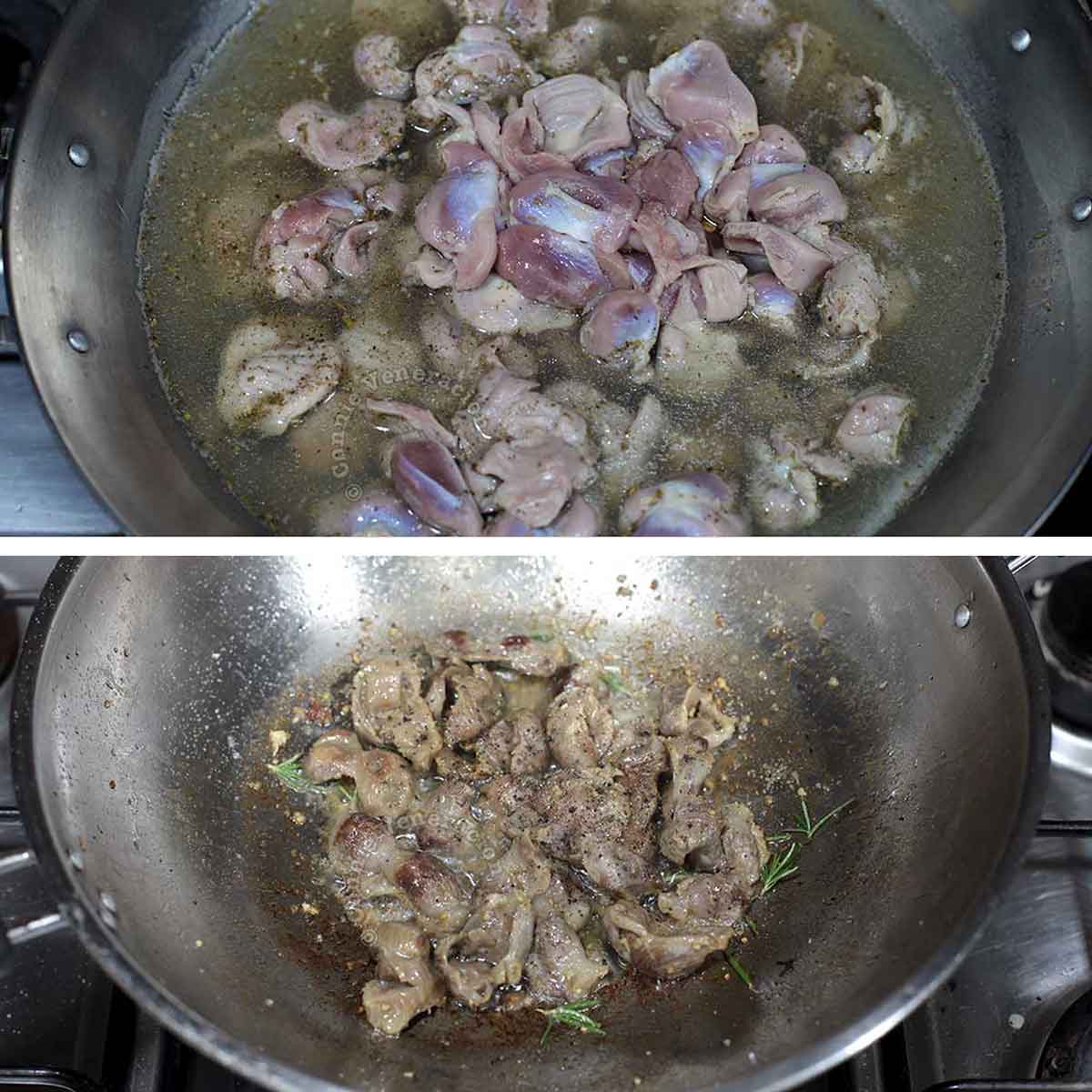
To tenderize chicken gizzards, place them in a pan, cover with water, add salt, pepper and whatever herbs and spices you desire then bring to the boil. If scum rises to the surface, just remove with a slotted spoon. Lower the heat, cover the pan and simmer the gizzards until tender. Depending on their size, this can take anywhere from an hour to two hours. Check the cooking liquid occasionally to make sure there’s enough. When the gizzards are tender, scoop them out and cool. Now, you can cut them into the size and shape required by the recipe.